Inherent Vice (USA: 2014): Strong style and mood cannot overcome a lost plot

inherentvicenewbannerlarge

Brief Review

If one could enjoy a movie for mood and setting alone, Inherent Vice may be the masterpiece of the year.  It is America of of 1970 that director P.T. Anderson is laying out, that time of hazy drugs and confused meanings when the entire country seemed to have completely lost the post-war plot. That the rootlessness of the times overwhelms the characters is understandable, but at 2 1/2 hours, viewers may become restless at the meandering developments that always seem to be leading somewhere, but which never reach any specific conclusion.

Rating
Continue reading

The Usual Suspects (USA: 1995): A review at 20

The first in a periodic series of reviews of films celebrating milestones in 2015

Release Date: January 25, 1995

It is difficult to believe that The Usual Suspects is 20 already. Bryan Singer’s mid-1990s pulp about five criminals attempting a heist to save their lives seemed to be pointing the way toward a noir future when it was released. It seems like just yesterday we were talking about a twist ending that “we never saw coming.” Sure it wasn’t The Crying Game (1992) levels of twisted, but I think we were out of the practice of watching suspense tales unfold, so the question of “Who Is Keyser Soze?…If he even exists” was fresh for us without long film memories at the time.

Kevin Spacey won his first Oscar for his role in the film. Christopher McQuarrie also won an Oscar for original screenplay. Both screenwriter and director would pair up again several times in much bigger budget fare – most notably X-Men, Jack, the Giant Slayer, and Valkyrie. As far as independent movies go, it could be considered a success. Below are four questions to contemplate at 20:

Continue reading

Mr. Turner (UK: 2014): Timothy Spall and a 349 degree view of an artist

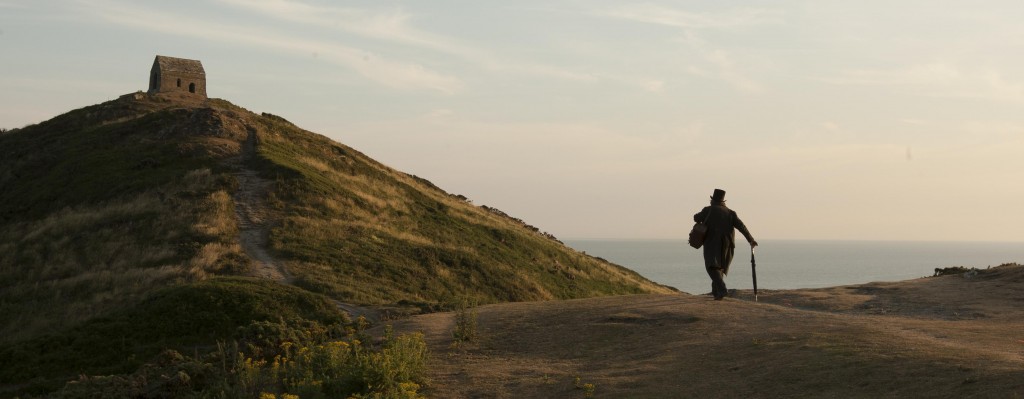
Mike Leigh’s Mr. Turner presents as close to a 360 view of a character as I think one can have on film without employing a cat scan. It is outstanding, if a bit long. I am not certain who is going to be nominated next month for best actor for the Academy Awards, but if Timothy Spall isn’t at least in the mix, I am not certain what an actor has to do to get there. I guess maybe he could talk more and grunt less, but my goodness, he takes to the role of the English painter JMW Turner with zeal.

Mr.-Turner1-1024x399

The film is a domestic and social portrait of one of the pivotal artists in history during the last 25 years of his life. Turner kept sketchbooks but he was not a diarist, so we don’t have any deep insights into what he was thinking at any particular time. The movie is true to that mystery. The social scenes in the movie are probably drawn the letters and diaries of others who met him. But even without the deep psychological study, Leigh has produced one of the most advanced profiles of an artist and his times that I have seen.

Continue reading

The Imitation Game (US/UK: 2014): Turing tells tall tales about himself.

The Imitation Game is framed as a story relayed by Alan Turing (Benedict Cumberbatch) to a detective (Rory Kinnear) to prove that he is human. I guess that would explain why the events presented in the bio-pic stray so far from actual events. Thinking machines can do many things, but deception, self-aggrandizement, and distortion aren’t among them just yet. When machines can take facts and think to themselves, “you know it would make a better story if we reordered them and maybe introduced a tragic flaw” then we will know that our days are numbered. Based on that standard, we’re safe or a few more decades. We want machines to solve problems that are too complex for us to solve, not machines that can do things we’re perfectly efficient performing. We can take comfort in the fact that we can still beat machines when it comes to story telling. But I am not so smug in my comfort as to let screenwriter Graham Moore and director Morten Tyldum off the hook for this parody of the life of Alan Turing.

Continue reading

Library Wars (Japan: 2013): Tales of war, stacks and romance

Library Wars is one of those Japanese pop phenomena that appears in all formats in rapid succession. It started its life as a light novel series, then a manga, then an animated TV series, then an anime feature film two years ago, followed by the live action film that I am reviewing today. If the process goes on, there will be a live action 10 part drama, followed by a live action film of that drama, followed by another TV series. I guess we do something similar here in the USA with comic book heroes and Star Wars, but we really don’t have the habit or process in place to release the same story in various formats so swiftly. When this rapid fire process happens in Japan, it usually means that we are dealing with a product aimed at younger audiences, and in this case, younger female audiences. With that in mind, I will review the Library Wars live action movie with a bit of caution. Not being Japanese, a teenager, or a woman of any sort, I’m not the target market. Is this a movie worth watching?

Continue reading

Into the Woods (USA: 2014): Fantasy without advancing armies is hard

There was a time when inserting an army into a film meant hiring and outfitting a large cast. CGI has made raising one no more costly than shooting any other scene, so our fantasy worlds have been filled with siege engines, legions, giant trolly things and whatnot for quite some time. Simple magic is no longer enough, and its existence in film has become tied to armies and epic saga, even in the fairy tales. Sure, we would like to update and recast these stories for modern times, but that hasn’t meant making them more psychologically challenging or complex. Instead that has meant Tolkienizing everything. Jack the Giant Slayer, Maleficent, Oz the Great and Powerful all have their pitched battle scenes. It’s not enough for Jack to get one giant mad at him any longer. We need thousands of giants wearing armor trying to take over the earth. I bring this up because I was very nervous after watching the trailer for Into the Woods, with its crumbling castle, that somehow, someone would think that in moving Sondheim’s musical modernization of Grimm to the screen, it would be a good idea to add a battery of trebuchets because they are cheap.

Continue reading

Big Eyes (USA: 2014): A major fraud it was. A major story, it wasn’t.

The setting for much of Tim Burton’s Big Eyes is late 1950’s early 1960s San Francisco. Bruno Delbonnel and supporting crew have done an excellent job capturing the city. I don’t think that period has been captured on film so splendidly since Vertigo. It is bright, incredibly hip, vibrant and cool at the same time and there are constant reminders that on a sunny day, there is probably no more gorgeous city on earth for a view of the world. I often found myself wondering where they found or created such pristine examples of 1950s storefronts and neighborhoods. I know a little of how the magic works, but I was impressed by the exterior vistas and the mid-century interiors of the movie. If Margaret and Walter Keane (Amy Adams and Christoph Walz) weren’t such a tense couple going through marital troubles, I probably would have wanted to move right in with them. Unfortunately, I seldom am willing to recommend a film based on technical production quality alone. I found the picture as a whole to be just so-so. There just isn’t enough of a story here to be interesting.

Continue reading

Why Don’t You Play in Hell (Japan: 2013): A light comedy served with 1,000 gallons of blood

Sion Sono’s Why Don’t You Play in Hell traces its roots back to yakuza films, kung fu classics and light romances. It tells the story of a group of guerrilla film-makers fated to make one masterpiece together. That the film is about two yakuza gangs fighting a final battle with each other would not be noteworthy, except that the film is financed by the one of the gangs and involves an actual raid and fight to death. Beyond the buckets-of-blood stylings of the film, there is a little something for everyone, and as far as Japanese comedies go, it is accessible to western audiences.

Continue reading

Gerontophilia (Canada: 2013): The Subtle Side of Bruce LaBruce

Rating:

3stars.PNG

To start with, let’s dispel the idea that Bruce LaBruce’s Gerontophilia is somehow the “Gay Harold and Maude.” Since there aren’t that many comedies, or dramas for that matter, about the subject of young men romantically linked to senior citizens, I can see why looking for a comparison to the best-known example on film would be natural, but these really aren’t the same film. I guess one can say that in both films a rather distant young man learns about life from an a senior citizen lover so they are loosely equivalent. But I think that the fact that we make such comparisons points to the fact that there aren’t many films out there on the topic. Just because the pairing of Lake (Pier-Gabriel Lajoie) and Mr. Peabody (Walter Borden) happens to be of two men doesn’t diminish or increase the unease we may feel about their relationship. LaBruce isn’t making a “gay” anything here. Instead he’s making a fairly straightforward film about a type of relationship that isn’t often put on film. Unlike Harold and Maude the young male isn’t learning to appreciate life, but trying to understand and act on his desires and learn how to deal with the trials of dating men in their 70s and 80s.

Continue reading

Night at the Museum: Secret of the Tomb (USA: 2014): On Parenting and Museums

As a series, the Night at the Museum films have been mostly premise without much payoff for adults. However, I think the first one was among the best zany, live action kids films released by Hollywood in the past decade (that’s not saying much). The second one had lost its purpose and the final installment has suffered from that derailment. If we ignore the special effects, at its heart, Night at the Museum had been about a father an son overcoming divorce and a loss of respect. A bumbling father made good, so to speak. The parenting issues were dropped from the second installment, and that film simply became a special effects comedy at the Smithsonian instead of the American Museum of Natural History. The father and son were simply best friends. Secret of the Tomb attempts to bring the family drama back into the picture, but awkwardly in a way that makes the picture pure juvenile fantasy.

Continue reading