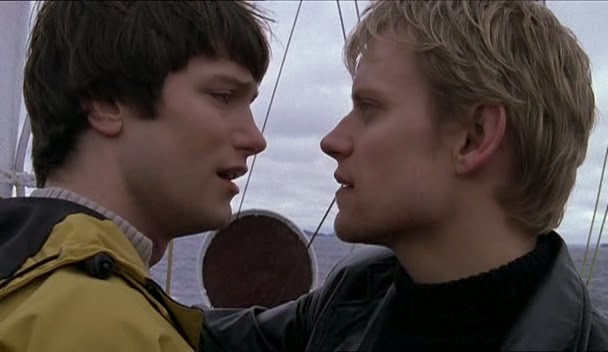
Lee Williams and Marc Warren: Blink and you’ll miss the acting
The whole effort is blandly acted and forgettable. Need proof? I had forgotten I had watched it before.
Rating


Lee Williams and Marc Warren: Blink and you’ll miss the acting
Rating

Ko Zandvliet and Gijs Blom
Rating
An entry in a periodic series of reviews of films celebrating milestones in 2015


Release Date: August 18, 1985

Cha, looking exhausted. You may be, too.

The Imitation Game is framed as a story relayed by Alan Turing (Benedict Cumberbatch) to a detective (Rory Kinnear) to prove that he is human. I guess that would explain why the events presented in the bio-pic stray so far from actual events. Thinking machines can do many things, but deception, self-aggrandizement, and distortion aren’t among them just yet. When machines can take facts and think to themselves, “you know it would make a better story if we reordered them and maybe introduced a tragic flaw” then we will know that our days are numbered. Based on that standard, we’re safe or a few more decades. We want machines to solve problems that are too complex for us to solve, not machines that can do things we’re perfectly efficient performing. We can take comfort in the fact that we can still beat machines when it comes to story telling. But I am not so smug in my comfort as to let screenwriter Graham Moore and director Morten Tyldum off the hook for this parody of the life of Alan Turing.
Rating:
To start with, let’s dispel the idea that Bruce LaBruce’s Gerontophilia is somehow the “Gay Harold and Maude.” Since there aren’t that many comedies, or dramas for that matter, about the subject of young men romantically linked to senior citizens, I can see why looking for a comparison to the best-known example on film would be natural, but these really aren’t the same film. I guess one can say that in both films a rather distant young man learns about life from an a senior citizen lover so they are loosely equivalent. But I think that the fact that we make such comparisons points to the fact that there aren’t many films out there on the topic. Just because the pairing of Lake (Pier-Gabriel Lajoie) and Mr. Peabody (Walter Borden) happens to be of two men doesn’t diminish or increase the unease we may feel about their relationship. LaBruce isn’t making a “gay” anything here. Instead he’s making a fairly straightforward film about a type of relationship that isn’t often put on film. Unlike Harold and Maude the young male isn’t learning to appreciate life, but trying to understand and act on his desires and learn how to deal with the trials of dating men in their 70s and 80s.
Rating:
The trailer I found actually isn’t very helpful to understanding REC, Joon-moon So’s 2011 short film about two men on their fifth anniversary. Young-joon (Sam-dong Song) and Joon-seok (Hye-hun Jo) have rented a hotel room and in their own little world, make a video recording of their night. They joke that in gay-relationship years, one year equals ten years of heterosexual marriage, so in a sense, they have outlasted most marriages. In the first half of the movie, they are happy, a little too playful, even. Beyond a record of their sexual encounter, they interview each other about their feelings. Joon-seok’s disappointment with his partner is that he never gives in for choices of restaurants and movies, a fairly common complaint for all couples. His biggest fear however comes from the fact that even after five years, Young-joon still believes that this relationship is only temporary. That offhand joke about gay relationship equivalent years isn’t actually so funny in that context.
Rating

Hee-il Leesong directs films about tumultuous relationships between pairs of men that swing from romantic love to contempt and violence. He is one of the best directors of films about same sex relationships working today. His films may be aimed at his local Korean audience, but his storytelling and technical skills can easily be appreciated outside of that country. He is probably best known for No Regret (2006), which was the first gay film released widely in Korea. That film centered on an orphan and an wealthy man swept up in a tempest of obsession, disdain, romance, revenge and finally love. If you asked me what a hero was in a Leesong movie, it would be a man who refuses to be heartbroken without first putting up a fight. White Night and the two companion short films, Going South and Suddenly Last Summer, follow up on that idea through the parings of an expatriate flight attendant and a messenger, a private and his former sergeant and a teacher and pupil, respectively.
Warning: Trailer contains nudity
Rating:
Voyage is Hong Kong director Scud’s fifth film. Audacity would be a good one-word summary of Scud’s output to date, and those who have appreciated that about his films will not be disappointed. Like his previous films, Voyage has plenty of obscure and sometimes idiosyncratic symbolism and allusions, abundant full nudity, saturated colors, explanatory texts, and a very negative story about love. Scud is not a director for the modest. The film is a series of shorts on the themes death, depression and and the afterlife, framed as stories being written by a psychiatrist (Ryo van Kooten) as he travels on his yacht with the intention of determining whether or not to take his own life.
Rating:
The Way He Looks is Daniel Ribeiro’s first feature film. The movie started it’s life in 2010 as a well-received short, I Don’t Want to Go Back Alone, which told the story of a blind teenager who falls in love with a new student. That movie climaxed with one of the sweetest stolen kisses I’ve seen recently. I was glad to find out that Ribeiro was given the opportunity to expand the short into a full movie and that the movie is Brazil’s submission for Oscar consideration this year. That submission was probably one of the reasons it was picked up for distribution to US theaters for limited release.
I Don’t Want to Go Back Alone was a very simple budding romance story, and there was quite a bit that could have gone wrong in expanding it to 95 min. There needs to be complications at that length, and complications can ruin simple love stories beyond recognition. The movie actually highlights this issue in the opening scene. Leonardo (Ghilherme Lobo) and his best friend, Giovana (Tess Amorim) laze by her pool and discuss whether they will ever be kissed. They both want their first kisses to be special – romantic, but without drama. Romance without complicating drama is how I’d describe the short, and I wondered what obstacles Ribeiro was going to throw out there to make it more difficult for Leo and Gabriel (Fabio Audi) to get together.
 Peale's BL Perspectives